
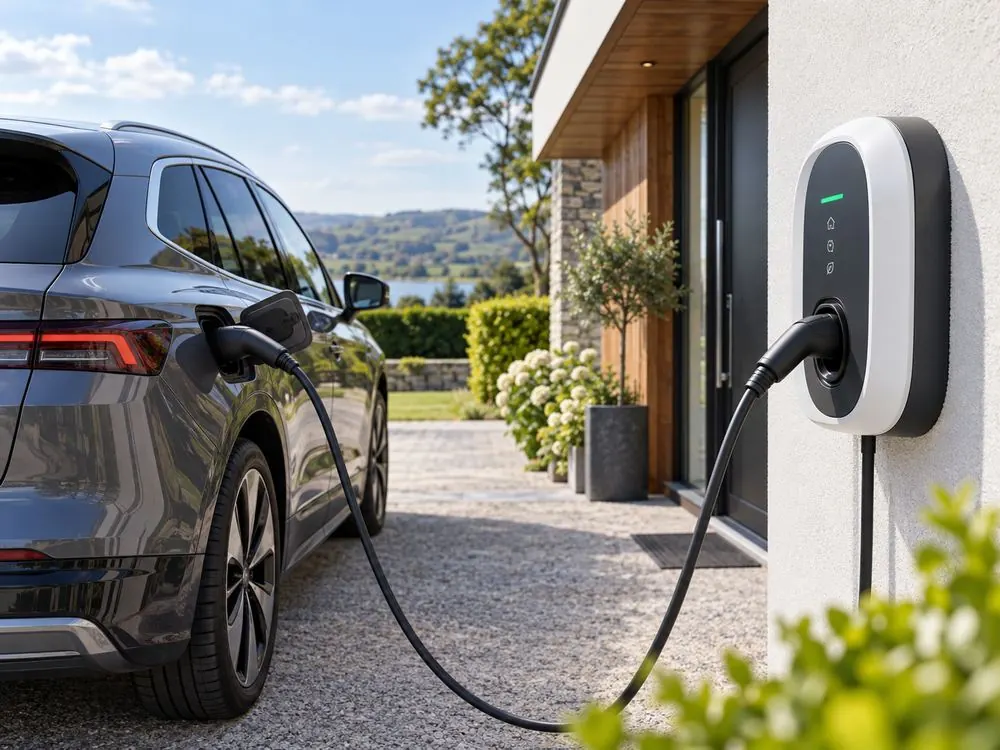
For most home chargers the answer is simple: overnight. A typical 7kW home charger adds roughly 35–40km of range an hour, which replaces a 40–50km day of driving in about an hour and fills most batteries in a night. A standard 3-pin socket is far slower: it can take the best part of a day to add what a proper home charger adds in a few hours.
How to work out your own charging time
The formula is simple: charging time (hours) = energy needed (kWh) ÷ charger power (kW), plus roughly 10% for charging losses.
For example, a 60kWh car charged from 20% to 80% needs 36kWh. On a 7.4kW charger that is 36 ÷ 7.4 = 4.9 hours, or about 5.4 hours once you allow for losses.
Approximate time to charge from 20% to 80%, including about 10% losses
| Battery size | Energy added | 3-pin socket (2.3kW) | 7kW home charger (up to 7.4kW) | 11kW, three-phase |
|---|---|---|---|---|
| 40 kWh | 24 kWh | 11.5 hrs | 3.6 hrs | 2.4 hrs |
| 60 kWh | 36 kWh | 17.2 hrs | 5.4 hrs | 3.6 hrs |
| 75 kWh | 45 kWh | 21.5 hrs | 6.7 hrs | 4.5 hrs |
Your car may charge more slowly than the charger allows, and 11kW needs a three-phase supply that most homes don't have.
What you get per hour
At around 5km of range per kWh, which is typical for many electric cars:
- 3-pin socket (2.3kW): about 11km an hour
- 7kW home charger (up to 7.4kW): about 37km an hour
- 11kW three-phase charger: about 55km an hour
Why your real charging time may differ
- Your car's onboard charger. Many cars limit AC charging to 7.4kW or 11kW, and some older models charge more slowly. A faster charger won't make the car charge faster than it allows, so check the handbook.
- Charging slows near the top. The last 10–20% usually takes longer, which is why 20–80% is the usual benchmark.
- Cold weather. A cold battery charges more slowly, and the car uses more energy to heat itself.
- Your home's electricity supply. Most homes have a single-phase supply, which tops out at around 7.4kW. An installer should check that your electrical board has spare capacity before choosing a charger.
Can I just use a 3-pin socket?
You can for occasional top-ups, but it is slow, and ordinary sockets weren't designed for hours of continuous high load. For regular car charging at home, a dedicated charger on its own circuit is safer and about three times faster. In Ireland that work should be done by a registered electrical contractor, such as one registered with Safe Electric, who will provide a completion certificate.
Charging from your own solar
If you have solar panels, timing matters as much as speed. Panels only reach their peak output around midday on a bright day, so charging from solar alone is usually slower than charging from the grid. Smart chargers such as the myenergi Zappi, which we install, can charge from surplus solar, from a mix of solar and grid power, or at full speed. That suits you if you are home during the day or plug in at weekends.
If you are out all day, charging overnight is usually simpler, and a home battery can move some daytime solar into the evening. See Is a home battery worth it in Ireland? for how to judge that.
Choosing the right charger for your home
Before you pick a charger, an installer should check your supply, your electrical board and the cable route to where you park. Those decide what speed you can safely have, and a faster charger isn't always the better choice for your home.
Thinking about a home charger?
We install myenergi Zappi chargers across Dublin and Leinster. Tell us about your home and your car and we'll recommend the right setup.
Get a Free QuoteTimes and ranges are estimates. Your car, battery, charger and conditions will change them.